
In today’s increasingly digital education environment, institutions must demonstrate compliance with evolving federal and state regulations to maintain Title IV eligibility—particularly around attendance verification. This challenge becomes even more complex in asynchronous online learning, where traditional notions of “attendance” don’t apply. IntelliBoard provides a data-driven solution that empowers institutions to meet these requirements with transparency, accuracy, and flexibility.
Redefining Attendance: From Presence to Participation
In traditional classrooms, attendance has been simple to define: students are either physically present or they’re not. But in online, asynchronous learning environments—where students engage with content on their own time—the concept of “attendance” is much harder to pin down.
Recognizing the limitations of legacy definitions, multiple state community college systems have partnered with IntelliBoard and state auditors to develop a more meaningful and auditable approach to tracking student participation in online courses. The result is a practical interpretation of ongoing attendance—not as simple logins or clicks, but as active engagement. IntelliBoard supports this definition by tracking verifiable learning behaviors: submitting assignments, participating in discussions, and completing quizzes.
These student-generated artifacts provide more than just audit-friendly documentation—they are also proven indicators of academic success. Unlike passive metrics like page views, these actions represent genuine cognitive engagement and help institutions align attendance reporting with educational outcomes.
__________
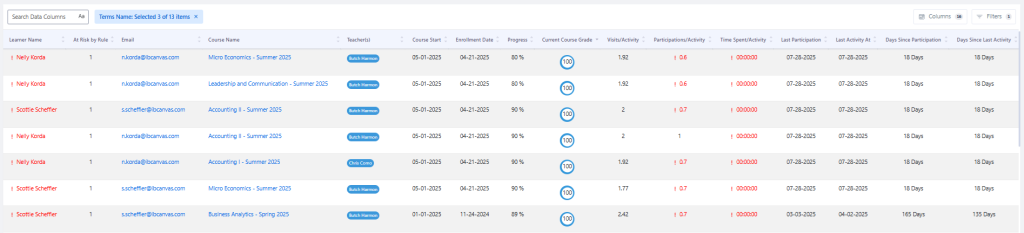
IntelliBoard’s Learner Participation Metrics report shows per-course stats for student engagement.
__________
Supporting Institutional Decision-Making and Audit Readiness
In collaboration with a state college system, IntelliBoard helped administrators and auditors navigate Title IV attendance policies by clearly identifying which types of student activity are measurable and meaningful. IntelliBoard allowed each institution to select from a menu of engagement indicators—from assignment submissions to quiz participation—and empowered stakeholders, including state auditors, to decide which of these should count as attendance for compliance purposes.
This approach withstands the scrutiny of state and federal audits because the underlying data—such as discussions, quizzes, and assignments—is archived natively within the LMS backups. These artifacts are stored long-term, retrievable even years later if needed for verification.
Enabling Instructor Judgment with Integrated Dashboards
Increasingly, instructors are required to enter attendance data weekly or biweekly into the SIS (Student Information System). IntelliBoard makes this new data collection requirement manageable for instructors by summarizing activity information with individual learner participation data across an entire course. Institutions publish tools like the library default Enrollment Course Progress Monitoring dashboard directly to instructors inside their LMS. This gives faculty immediate visibility into engagement metrics they can trust—such as assignment completion and quiz activity—rather than relying solely on raw access data.
This integration is critical because instructors understand the context of the tools they assign. At present, many instructors incorporate third-party tools into their online courses via LTI (Learning Tools Interoperability) to provide richer experiences for learners, but detailed tracking of learner engagement is not available within the LMS. At best, the external tool returns only a grade and/or a completion status. Some tools only track that the learner clicked on the tool. Although future advances like xAPI may offer more comprehensive tracking, IntelliBoard focuses today on what can be measured reliably and defensibly. The instructors who designed the courses know whether a grade returned from an external tool represents meaningful engagement or a passive click. IntelliBoard doesn’t replace instructor judgment; it strengthens it by centralizing the data they need to make informed decisions.
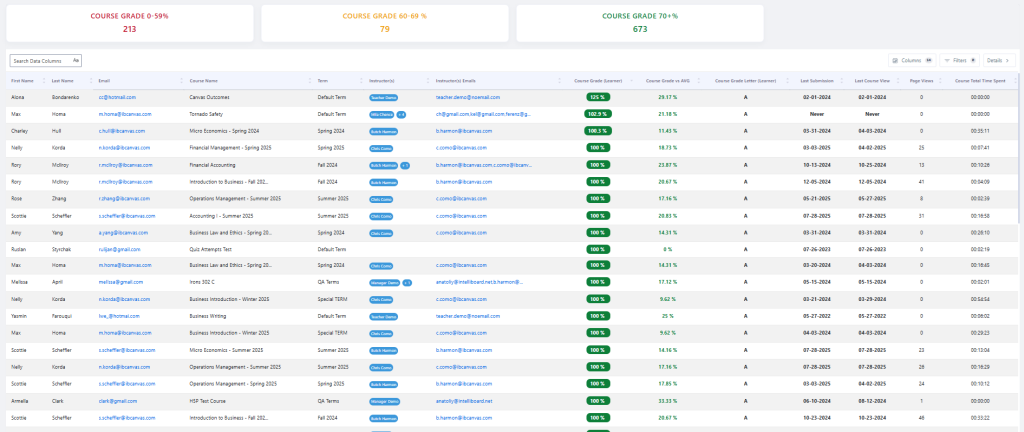
IntelliBoard’s Learner Course Progress Monitoring report shows how students are doing in a course along with important metrics.
Addressing Inactivity and Early Intervention
IntelliBoard also helps institutions automate instructor and student notifications based on patterns of inactivity—such as no course access in 10 or 14 days. These alerts are tailored to the institution’s term lengths and delivered with a supportive tone, nudging learners back into action while offering help if needed.
Rather than sending messages based on superficial logins, IntelliBoard’s alerts can be triggered by a lack of engagement—no artifact submissions, no meaningful interaction. Institutions are able to customize these thresholds and align them with their academic calendars by synchronizing with student information systems (SIS) to pull canonical start and end dates, further improving consistency and reducing reliance on manually updated course settings.
Conclusion: Compliance That Supports Learning
Title IV compliance doesn’t have to be a burden. With IntelliBoard, institutions can confidently define, track, and report attendance based on actions that matter—while empowering instructors and administrators to make informed decisions backed by real data.
Whether your goal is audit-ready documentation, early intervention for at-risk students, or better visibility into student behavior across asynchronous courses, IntelliBoard helps transform compliance into an opportunity to support learning and retention.
Want help implementing this model at your institution? Let’s talk.
Share This Story, Choose Your Platform!

Elizabeth Dalton
Elizabeth Dalton measures and improves educational tools, processes, and results by using her experience in instruction and assessment design, development, documentation, and delivery, combined with knowledge and expertise in technology and statistical methods.