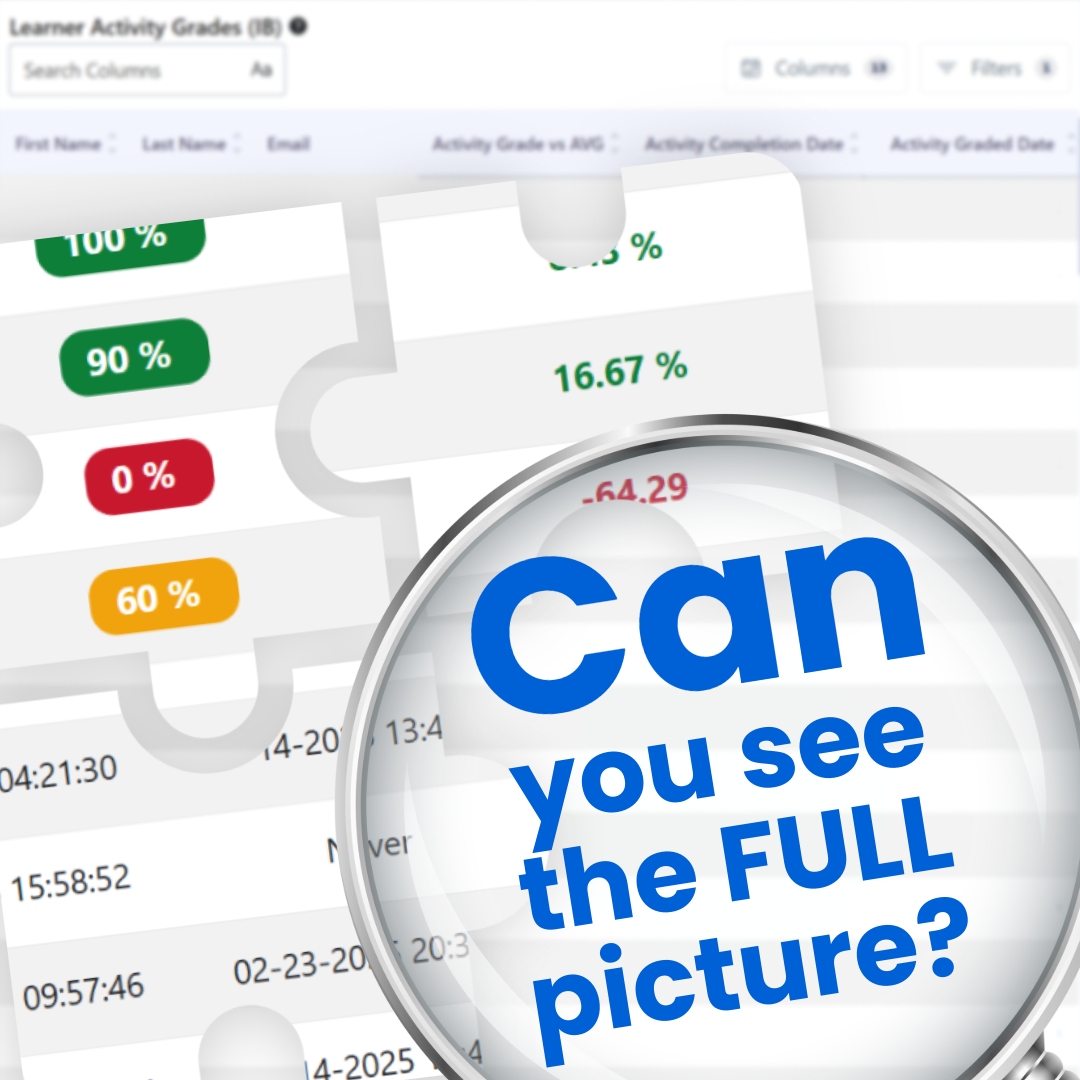
Can You See the Full Picture?
Your LMS Shows Activity, Not Insight: Why LMS Analytics Fall Short
Native LMS analytics have become a standard tool in higher education. They offer quick visibility into logins, submissions, grades, and participation. On the surface, that feels like a solid view of what’s happening in a course.
And those metrics are useful.
But they only tell part of the story.
For institutions focused on student success, retention, and operational efficiency, LMS analytics alone aren’t enough. Because activity is not the same as insight. And surface-level engagement doesn’t reveal the full picture of what students need to succeed.
The Limits of LMS Analytics
Learning management systems were designed to support course delivery. Their analytics tools naturally reflect that purpose, focusing almost entirely on what happens inside the course environment.
They show how often students log in, whether assignments are submitted, and how grades trend over time. These reports help instructors understand engagement within a single course.
But it stops there.
Native LMS analytics do not pull in the broader institutional data that academic leaders rely on to understand student progress in context. This creates one of the biggest challenges in higher education analytics today: data silos.
When the Most Critical Data Lives Outside the LMS
Most of the information that impacts student success doesn’t live inside the LMS alone.
Key data is spread across multiple systems including:
- Student Information System (SIS) data
- First submission records
- Financial aid and compliance information
- Historical performance and progression trends
- Risk indicators across courses and terms
Institutions are forced to piece together reports manually. The result is fragmented visibility and delayed action.
How Disconnected Data Hurts Student Success
When institutions rely solely on native LMS analytics, a common set of challenges appears.
Staff lose valuable time manually pulling data and generating reports. At-risk students are identified later than they should, often after grades drop or disengagement becomes obvious. Opportunities for early intervention are missed. And leadership teams make decisions without the full picture.
Teams work harder, but without a complete understanding of what’s happening across the institution. Without the full picture, patterns stay hidden. Trends across programs, departments, and the institution are difficult to see. And without those insights, action comes too late.
From LMS Activity to Institutional Insight
LMS analytics do a great job answering narrow, course-level questions.
Who logged in this week?
Who submitted an assignment?
What are the average grades in this course?
But institutional leaders need to answer much bigger questions:
Which students are showing early risk signals across courses before grades drop?
Which attendance and engagement patterns are most closely tied to student success and attrition?
Where are performance and engagement issues emerging across departments and programs?
How are retention, engagement, and outcomes changing term over term?
These insights require more than LMS data can provide, they require data from across the institution.
The Power of Full Picture Learning Analytics
When LMS data is integrated with other critical information, outcomes, and risk indicators, institutions gain a complete view of the learner journey.
Instead of seeing isolated moments of activity, teams can follow students across courses and terms. They can spot risk earlier, understand what is driving disengagement, and intervene before problems escalate.
Full Picture analytics enable teams to:
- Identify at-risk students earlier
- Track trends across programs and departments
- Respond faster with trusted data
- Reduce reporting time and inefficiencies
Instead of reacting after problems surface, institutions can take proactive steps to support learners.
Seeing the Full Picture Changes Everything
Native LMS analytics will always play a valuable role in course-level visibility.
But surface-level activity alone won’t drive institutional improvement. To truly improve retention, outcomes, and efficiency, academic leaders need trusted, critical data from multiple sources that live outside the LMS.
Because you can’t improve what you can’t see.
And you can’t make confident decisions with half the picture.
Are you seeing the full picture, or just surface-level activity?
Explore how IntelliBoard reveals what native LMS reports can’t.